
Quick Answer
The best echinacea companion plants are other sun-loving, drought-tolerant perennials that thrive in lean soil -- think black-eyed susans, rudbeckia, ornamental grasses like little bluestem, and native sedums. These prairie neighbors share the same growing requirements and look stunning together without competing for resources [1]. The plants you want to keep away from your coneflowers are heavy feeders, moisture-loving species, and aggressive spreaders like mint that will crowd echinacea out of its own bed.
Key Takeaways
- Prairie natives make the best partners: Black-eyed susans, rudbeckia, little bluestem, and switchgrass evolved alongside echinacea and share its preference for full sun and well-drained soil.
- Native sedums fill the ground layer: Low-growing sedums suppress weeds around echinacea stems while tolerating the same lean, dry conditions.
- Avoid heavy feeders and wet-soil lovers: Plants that demand rich, moist soil -- like hostas, astilbe, or heavily fertilized annuals -- create conditions that promote root rot in echinacea.
- Keep aggressive spreaders far away: Mint, bee balm, and other rhizomatous spreaders will invade echinacea's root zone and outcompete it for space and nutrients.
- Companion plantings boost pollinator diversity: Pairing echinacea with staggered-bloom companions can provide continuous nectar from late spring through hard frost, supporting over 150 pollinator species [1].
What Are the Best Companion Plants for Echinacea?
If you want a garden bed that basically takes care of itself, the trick is to pair echinacea with plants that grew up in the same neighborhood. Purple coneflower (Echinacea purpurea) is native to the prairies and open woodlands of central and eastern North America, where it thrives in full sun, well-drained soil, and conditions that would make a rose bush weep. The companions that work best are the ones that share that same tough-as-nails DNA.
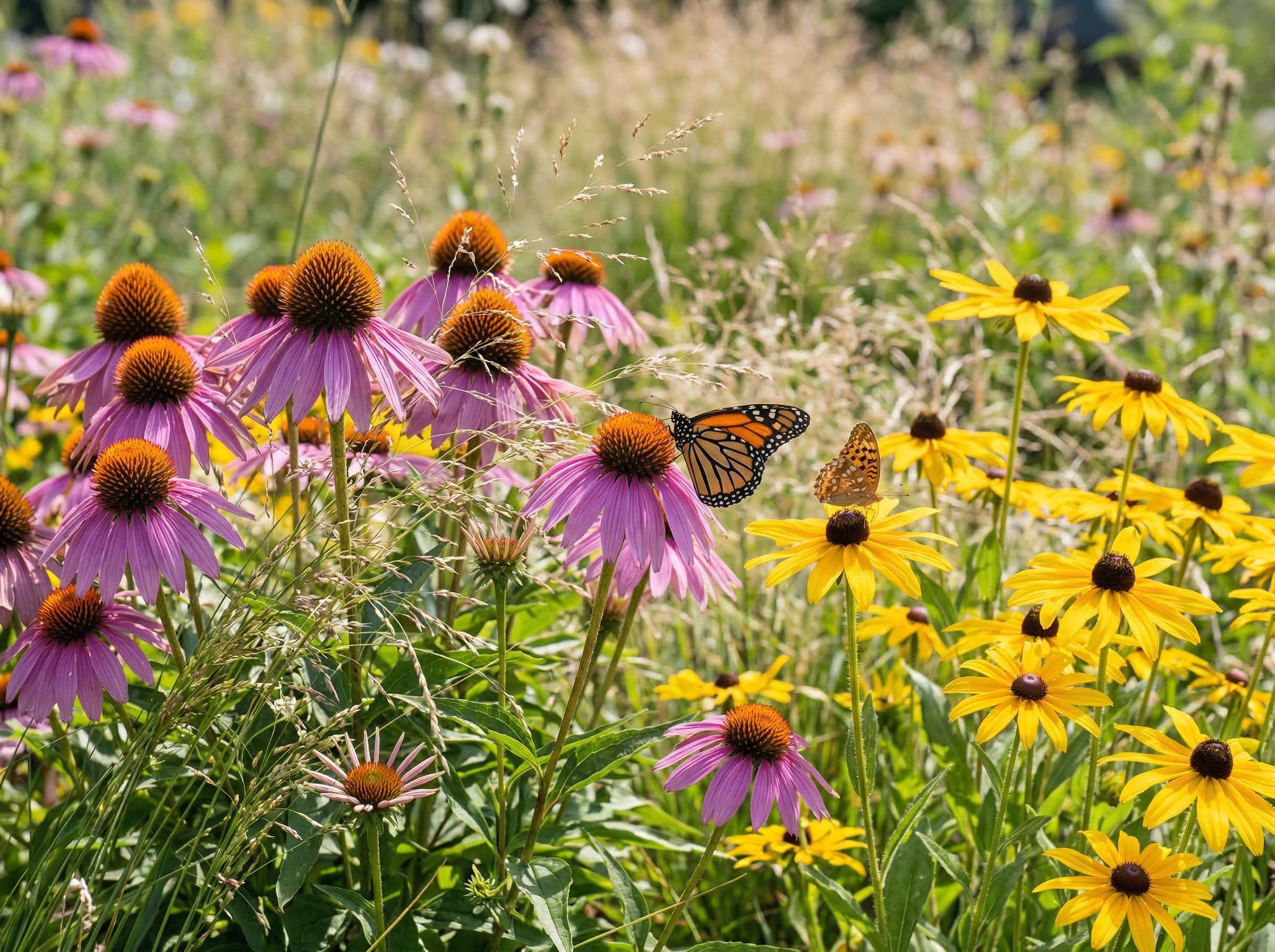
Black-eyed susans (Rudbeckia hirta) are probably the single most popular pairing, and for good reason. They bloom from June through October [3], overlapping beautifully with echinacea's mid-summer-to-frost window [2]. The golden-yellow petals against echinacea's purple cones create that classic prairie color palette that looks like it belongs on a seed catalog cover. Both plants handle heat, tolerate drought once established, and actually perform better in leaner soil. Space them 18 to 24 inches apart from your echinacea clumps so air can circulate freely -- good airflow is the cheapest fungicide you will ever use.
Perennial rudbeckia varieties like Rudbeckia fulgida 'Goldsturm' take that partnership a step further. While Rudbeckia hirta is technically a short-lived perennial that self-sows freely, 'Goldsturm' forms reliable, long-lived clumps that come back stronger each year. Plant them in drifts of three to five alongside your echinacea for that naturalized meadow look that landscape designers charge a fortune to create.
Ornamental grasses are the unsung heroes of any echinacea planting. Little bluestem (Schizachyrium scoparium), switchgrass (Panicum virgatum), and prairie dropseed (Sporobolus heterolepis) are all native grasses that evolved alongside coneflowers in wild prairie ecosystems. They add vertical texture and movement that makes your flower colors pop, and their deep root systems help break up heavy soil over time. The grasses also provide winter interest long after the flowers have faded -- those tawny seed heads catching frost on a January morning are something special. Space ornamental grasses about 24 to 36 inches from echinacea clumps, depending on the grass species' mature spread, so neither plant shades the other out [4].
Native sedums like Sedum ternatum (woodland stonecrop) or Sedum spurium fill the low ground layer that echinacea leaves wide open. Since coneflowers grow two to four feet tall on upright stems [2], there is a lot of bare soil at their feet where weeds love to move in. Low-growing sedums carpet that space, conserve soil moisture, and suppress weeds without competing for the root zone that echinacea occupies. They also tolerate the same lean, dry conditions and add a completely different leaf texture to the planting. For best results, plant sedum plugs about 8 to 10 inches apart around the base of your echinacea clumps in spring once the soil has warmed.
What Should You Avoid Planting With Echinacea?
Knowing what not to plant is just as valuable as knowing the perfect companions. Echinacea evolved in prairie soils that are naturally low in nitrogen and organic matter, and it actually performs worse in rich, heavily amended beds. This is one of those rare cases where less really is more.
Heavy feeders are the biggest mismatch. Plants like tomatoes, roses, dahlias, and most annual vegetables demand consistent fertilization and rich soil. When you feed those neighbors, the runoff and soil enrichment push echinacea into producing soft, leggy foliage that flops over and blooms poorly. If you have ever seen a coneflower that grew three feet of floppy stem with barely any flowers on top, odds are good it was getting too much nitrogen from a neighboring bed. Keep echinacea at least several feet from any area that gets regular fertilizer applications.
Aggressive spreaders are the other major threat. Mint is the poster child here -- any gardener who has planted mint in an open bed knows it will colonize every square inch of available soil within a single season. Its dense rhizomatous root system will physically crowd out echinacea's taproot and steal moisture and nutrients. Bee balm (Monarda), while a fellow native, can also spread aggressively via underground runners and may need regular division to keep it from overwhelming slower-growing coneflowers. If you love mint or bee balm, plant them in containers or in a separate bed with a root barrier.
Moisture-loving plants create the wrong microclimate for coneflowers. Species like astilbe, Japanese iris, ligularia, and swamp milkweed prefer consistently moist to boggy soil. Planting them near echinacea means either overwatering the coneflowers (which leads to crown rot and fungal problems) or underwatering the moisture lovers. It is a lose-lose pairing. Similarly, shade-loving plants like hostas and ferns signal a low-light environment that echinacea simply cannot tolerate -- coneflowers need at least four to six hours of direct sun daily to bloom well [2].
How Do Echinacea Companion Plantings Support Native Pollinators?
Here is where companion planting with echinacea goes from looking pretty to doing real ecological work. Native echinacea species support over 150 pollinator species [1], including honeybees, native bumblebees, leafcutter bees, sweat bees, and solitary bees. Butterflies flock to coneflowers too -- monarchs, tiger swallowtails, painted ladies, red admirals, skippers, and fritillaries are all regular visitors. Echinacea purpurea even serves as a larval host plant for the silvery checkerspot butterfly, which has two broods from May through September [1]. That is not just a nectar pit stop; it is a full-service maternity ward.
The real power of companion planting for pollinators is bloom-time stacking. Echinacea alone blooms from roughly mid-June through the first frost [2], which is a generous window. But pair it with early-blooming companions and late-season finishers, and you create an unbroken chain of nectar and pollen from spring through late fall. Black-eyed susans start pumping out flowers in June and keep going into October [3]. Native sedums bloom in late summer and early fall, filling any gaps. Ornamental grasses, while wind-pollinated themselves, provide critical overwintering habitat for beneficial insects -- many native bees nest in dead, hollow stems, which is why NC State Extension recommends leaving spent echinacea and grass stems standing through winter, cut to 12 to 24 inches tall [1].
One important note: stick with straight species and seed-grown varieties when your goal is pollinator support. Many heavily hybridized echinacea cultivars -- those double-petal types in coral and mango and chartreuse -- produce less nectar and pollen than wild-type plants. The classic purple coneflower (Echinacea purpurea) and pale purple coneflower (Echinacea pallida) remain the gold standard for pollinator gardens. Pair them with other straight-species natives, and your backyard becomes a genuine habitat corridor rather than just a pretty flower bed.
Frequently Asked Questions
Can you plant black-eyed susans next to echinacea?
Absolutely. Black-eyed susans (Rudbeckia) and echinacea share nearly identical growing requirements -- full sun, well-drained soil, and moderate drought tolerance. They bloom at overlapping times from mid-summer through fall, creating a striking purple-and-gold color combination that also extends the pollinator buffet in your garden.
Does echinacea spread and take over a garden bed?
Echinacea can self-sow, but it is not aggressive. Plants form clumps that slowly expand over the years, and volunteer seedlings are easy to pull or transplant. It is far less invasive than true spreaders like mint or bee balm, making it a well-behaved perennial for mixed borders.
Why is my echinacea not blooming well with other plants nearby?
The most common culprits are too much shade from neighboring plants and overly rich soil. Echinacea evolved in lean prairie soils, so heavy fertilization or nitrogen-hungry companions can push foliage growth at the expense of flowers. Make sure surrounding plants are not crowding your coneflowers out of their sunlight.
When should I plant echinacea companion plants in spring?
In most zones (3-9), plant echinacea and its companions after the last frost date when soil temperatures reach about 65 degrees Fahrenheit. For most of the country, that window falls between mid-April and late May. Starting in spring gives roots a full growing season to establish before winter.
TLDR
The best echinacea companion plants are fellow prairie natives like black-eyed susans, rudbeckia, ornamental grasses, and native sedums that share its love of sun and lean soil, while heavy feeders and aggressive spreaders like mint should be kept far away.
Sources:
1 NC State Extension - Echinacea purpurea Plant Profile 2 Clemson Cooperative Extension - How to Grow Echinacea 3 University of Maryland Extension - Black-Eyed Susan 4 University of Wisconsin-Madison Horticulture - Prairie Sun Black-Eyed Susan