
Quick Answer
The best black-eyed susan companion plants are native perennials that share similar sun, soil, and water needs -- think purple coneflower, salvia, ornamental grasses, and goldenrod. These pairings create a low-maintenance, pollinator-friendly garden that looks stunning from early summer through fall [1]. The key rule is simple: stick with clump-forming plants and avoid aggressive rhizome spreaders like mint that will muscle your rudbeckia right out of the bed.
Key Takeaways
- Coneflower is the classic partner: Purple coneflower (Echinacea purpurea) blooms at the same time and creates one of the most iconic color combinations in the native garden.
- Salvia and goldenrod extend the show: These companions overlap bloom periods to keep your garden colorful from June well into October.
- Ornamental grasses add structure: Switchgrass and little bluestem provide vertical interest, movement, and winter texture long after flowers have faded.
- Avoid mint and aggressive spreaders: Plants that spread by underground rhizomes will outcompete black-eyed susans for water, nutrients, and root space.
- Native pairings support pollinators: Grouping native plants together dramatically increases pollinator diversity and visit frequency compared to isolated plantings.
What Are the Best Companion Plants for Black-Eyed Susans?
If you are planting black-eyed susans this spring, you are already making a great choice. Rudbeckia hirta is one of the most adaptable, cheerful, and wildlife-friendly perennials you can grow in USDA zones 3 through 9 [3]. But the real magic happens when you surround them with the right neighbors. Here are the companions that genuinely earn their spot in the bed.
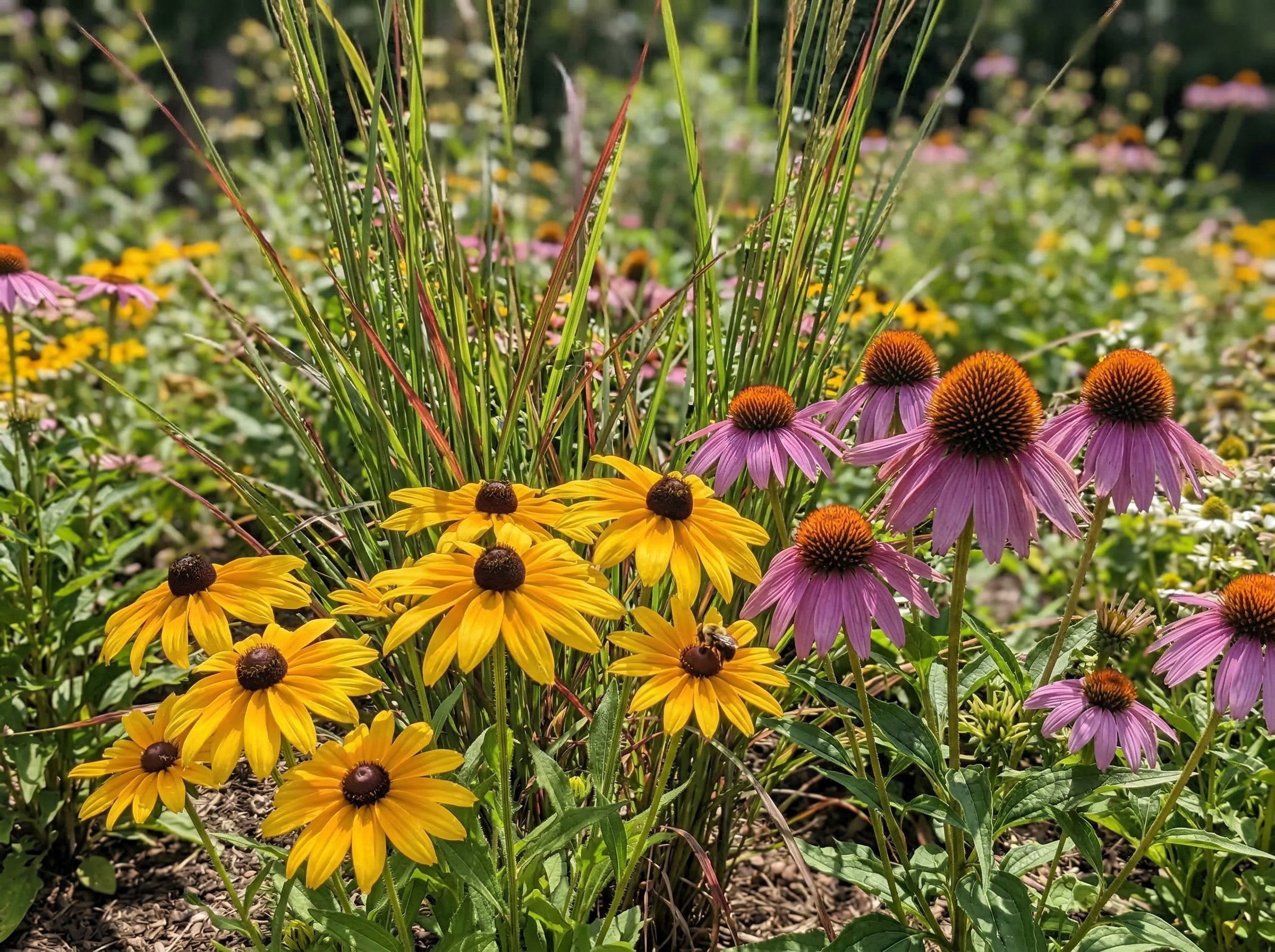
Purple Coneflower (Echinacea purpurea) is the single most popular companion for black-eyed susans, and for good reason. Both are native North American wildflowers that thrive in full sun and average, well-drained soil. They bloom at roughly the same time -- coneflower typically from June through August, with black-eyed susans carrying from June into October [1]. The color pairing of golden yellow against rosy purple is a garden design classic that looks effortless because, well, it is. Both plants grow to similar heights of two to three feet, so neither one shades the other out. Space them 18 inches apart and let them fill in naturally. Once established, both are drought-tolerant and rarely need supplemental watering, making this pairing about as low-maintenance as perennial gardening gets.
Salvia (Salvia nemorosa and native species) brings a different shade of purple-blue into the composition and adds a nice spike-shaped flower form that contrasts with the daisy-like blooms of rudbeckia. Meadow sage varieties bloom heavily in early summer and often rebloom in fall if you deadhead them after the first flush. They stay compact at 18 to 24 inches tall, tucking in neatly in front of taller black-eyed susans. Like rudbeckia, salvia thrives in full sun and does not appreciate soggy feet. Plant them 12 to 15 inches apart. The tubular flowers are magnets for hummingbirds and long-tongued bees, which means planting salvia next to your rudbeckia creates a one-stop shop for multiple pollinator species.
Ornamental Grasses -- particularly native species like switchgrass (Panicum virgatum), little bluestem (Schizachyrium scoparium), and prairie dropseed (Sporobolus heterolepis) -- are companion plants that many gardeners overlook, and that is a missed opportunity. Grasses provide fine-textured, vertical movement that makes the bold flower heads of black-eyed susans pop even more. The Missouri Botanical Garden notes that Rudbeckia hirta mingles particularly well with native grasses like Sorghastrum nutans (Indian grass) and Sporobolus heterolepis [3]. Switchgrass grows three to five feet tall and works beautifully as a backdrop behind your rudbeckia. Little bluestem stays more compact at two to three feet and turns a gorgeous copper-red in fall. Both grasses maintain their structure through winter, providing visual interest and shelter for beneficial insects even after the black-eyed susans have gone to seed.
Goldenrod (Solidago species) is an underrated companion that shares a bloom window with late-season black-eyed susans. Many gardeners shy away from goldenrod because they mistakenly believe it causes hay fever -- that culprit is ragweed, not goldenrod. Native goldenrod species are actually phenomenal pollinator plants and a critical late-season nectar source for migrating butterflies and native bees preparing for winter. Pairing goldenrod with black-eyed susans creates a sea of golden tones that is both ecologically powerful and visually cohesive. Space goldenrod 18 to 24 inches from your rudbeckia, and choose clump-forming species like showy goldenrod (Solidago speciosa) or stiff goldenrod (Solidago rigida) rather than the more aggressive Canada goldenrod.
Which Plants Should You Keep Away From Black-Eyed Susans?
Not every plant makes a good neighbor for rudbeckia. The biggest problems come from aggressive spreaders -- plants that colonize new territory through underground rhizomes rather than staying put in tidy clumps.
Mint (Mentha species) is the most common offender. All varieties of mint -- spearmint, peppermint, apple mint, and the rest -- spread relentlessly through horizontal underground stems that can travel several feet in a single growing season. Once mint rhizomes infiltrate your black-eyed susan planting, they form a dense root network that steals water and nutrients from your rudbeckia. Even a small fragment of mint root left in the soil can regenerate into a new plant, making removal extremely difficult once it has taken hold. If you want mint somewhere near your flower garden, the only safe approach is to grow it in a container -- either a pot above ground or a bottomless container buried at least 12 inches deep with the rim protruding above the soil line.
Other aggressive spreaders to avoid include bishop's weed (Aegopodium podagraria), chameleon plant (Houttuynia cordata), and common ribbon grass (Phalaris arundinacea). All three spread through vigorous rhizomes that will overwhelm a rudbeckia planting within a season or two. The distinction to understand is clump-forming versus rhizome-spreading growth habits. Black-eyed susans themselves do self-seed freely [3], but they spread by dropping seeds above ground -- you can easily pull unwanted seedlings. Rhizome spreaders operate underground where you cannot see the invasion happening until it is too late. When choosing companions, stick with plants that grow outward slowly from a central crown rather than sending runners in every direction beneath the soil.
You should also avoid planting tall, dense shade-creators directly to the south of your black-eyed susans. Rudbeckia needs at least six to eight hours of direct sunlight to bloom well and maintain sturdy, upright stems [1]. Heavy shade leads to leggy, floppy growth and increased susceptibility to powdery mildew, which is already one of the few disease issues rudbeckia faces.
Why Do Native Plant Pairings Matter?
Planting black-eyed susans with other native species is not just an aesthetic choice -- it is an ecological strategy with measurable benefits. Penn State Extension research notes that 18 species use Rudbeckia as a host plant in Pennsylvania alone, and the flower heads attract an exceptionally wide diversity of pollinators including bees, wasps, flies, beetles, moths, and butterflies [2]. When you surround your rudbeckia with other native companions like coneflower, goldenrod, and native grasses, you create a diverse habitat that supports the full life cycle of these pollinator species -- not just a quick nectar stop.
The Xerces Society recommends planting native species in groupings of at least three to five of each species to create meaningful pollinator habitat [4]. A single coneflower next to a single black-eyed susan is pretty, but a drift of each species planted together is exponentially more effective at attracting and sustaining pollinator populations. Aim for clusters rather than a mixed salad of individual plants. The visual effect is also more striking -- landscape designers call this "planting in drifts," and it is one of the easiest ways to make a home garden look intentional and cohesive.
Native companions also share practical advantages that make your garden easier to maintain. Because plants like coneflower, salvia, goldenrod, and native grasses evolved in the same regions and soil conditions as black-eyed susans, they have similar water needs, fertility requirements, and pest resistance. You will not find yourself overwatering one plant to keep another happy, or fertilizing heavily for a demanding companion while accidentally burning your rudbeckia. Native pairings also tend to build healthier soil over time. Their deep, fibrous root systems improve soil structure, increase water infiltration, and support beneficial soil microorganisms. A native companion planting essentially maintains itself once established, requiring little more than an annual cutback in late winter and occasional division every three to four years.
Frequently Asked Questions
What flowers look best planted next to black-eyed susans?
Purple coneflower (Echinacea purpurea) is one of the most popular companions because its purple-pink blooms create a striking contrast against the golden yellow of black-eyed susans. Salvia, goldenrod, and bee balm also pair beautifully and share the same growing requirements.
Can I plant black-eyed susans with ornamental grasses?
Yes, ornamental grasses like switchgrass (Panicum virgatum) and little bluestem (Schizachyrium scoparium) are excellent companions. They provide vertical texture, movement in the breeze, and winter interest after the black-eyed susans finish blooming.
Should I avoid planting mint near black-eyed susans?
Absolutely. Mint spreads aggressively through underground rhizomes and will quickly invade and outcompete black-eyed susans for water, nutrients, and space. If you want mint nearby, keep it confined to a buried container.
How far apart should I space black-eyed susans from companion plants?
Space black-eyed susans 12 to 18 inches apart from each other and from companion plants. Larger varieties need the full 18 inches, while compact cultivars can be planted at 12 inches. Good air circulation between plants helps prevent powdery mildew.
TLDR
The best black-eyed susan companion plants are fellow sun-loving natives like coneflower, salvia, ornamental grasses, and goldenrod, while aggressive spreaders like mint should be kept far away from the planting bed.
Sources:
1 University of Maryland Extension - Black-Eyed Susan 2 Penn State Extension - Black-Eyed Susan: Beautiful and Beneficial 3 Missouri Botanical Garden - Rudbeckia hirta Plant Finder 4 Xerces Society - Pollinator-Friendly Native Plant Lists